Monday, March 29, 2021

1960 IMO Problems And Solutions


Problem 01

Determine all three-digit numbers $N$ having the property that $N$ is divisible by 11, and $\dfrac{N}{11}$ is equal to the sum of the squares of the digits of $N$.

Solutions

Solution 1

Let $N = 100a + 10b+c$ for some digits $a,b,$ and $c$. Then\[100a + 10b+c = 11m\]for some $m$. We also have $m=a^2+b^2+c^2$. Substituting this into the first equation and simplification, we get

1959 Romania IMO | Problem 01

Problem 01 (1959 IMO)

Prove that the fraction $\frac{21n+4}{14n+3}$ is irreducible for every natural number. 

Solution 01 (Euclidean Algorithm)

Thursday, March 25, 2021

Cambodian Olympiad Math

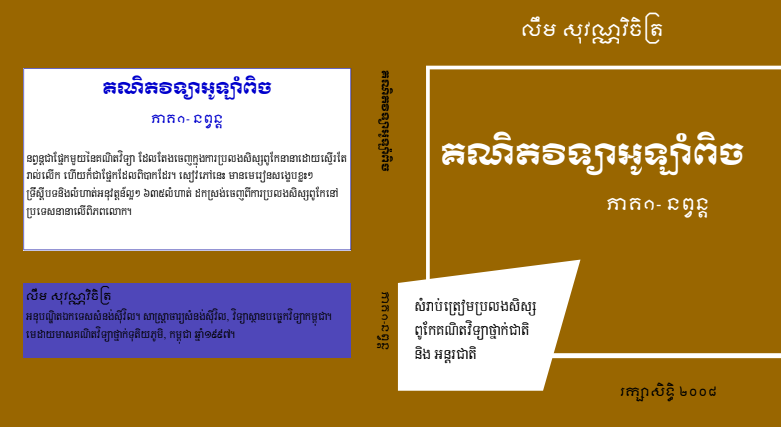
 Cambodian Olympiad Math is written by Lim Sovanvichet . This book is shared on social media by many students which is very important document for all Khmer students. In this book, there are many International Math Problems which he translated from other foreign books and wrote them in to Khmer language.

Download This Book Here:

Vietnames's Sequence Math

 This is a document that I research from the internet and rewrite it to upload at my website, I think It can help you do Math with different language which makes you to be better at Math. Why Vietnames students can challenge with other students around the world.

Here you can check out my collection.


Monday, March 22, 2021

When is \(n^2+2021n\) a perfect square?

Solution

Let \(m,n\in\mathbb{N}\) such that \(n^2+2021n=m^2\). Since \(2021=43\times47\), we have

\[ 4n^2+4\times2021n=4m^2 \]

Adding \(2021^2\) to both sides,

\[ (2n+2021)^2-4m^2=2021^2 \]

Therefore,

\[ (2n-2m+2021)(2n+2m+2021)=2021^2. \]

Case 1: \(2021^2=1\times2021^2\).

Then \(2n-2m+2021=1\) and \(2n+2m+2021=2021^2\). Adding both equations,

\[ 4n+2\times2021=2021^2+1\Rightarrow4n=(2021-1)^2, \]

so \(n=1020100\).

Case 2: \(2021^2=43\times(43\times47)^2\).

Then \(2n-2m+2021=43\) and \(2n+2m+2021=(43\times47)^2\). Solving similarly, we get \(n=22747\).

Hence, \(n^2+2021n\) is a perfect square when

\[ \boxed{n=1020100\ \text{or}\ n=22747}. \]

Here you can download the PDF file (Solution by Thin Sokkean)


Sunday, March 14, 2021

Irish Math Olympiad 2009

Find all positive integers \(n\) such that \(n^8+n+1\) is a prime.

Irish Math Olympiad 2009

Solution

Let \(f(x)=x^8+x+1\). If \(w\) is the third root of unity \((w=e^{2i\pi/3})\), then \(w^2+w+1=0\) and \(w^3=1\), so \(w^8=w^2\). Therefore, \(f(w)=w^8+w+1=w^2+w+1=0\). Hence, \(w\) is a root of both \(f(x)=x^8+x+1\) and \(x^2+x+1\), so

\[ f(x)=(x^2+x+1)g(x). \]

We have

\[ x^8+x+1=(x^2+x+1)(x^6-x^5+x^3-x^2+1). \]

Since \(f(1)=1^8+1+1=3\), \(n=1\) gives a prime number.

For \(n>1\),

\[ n^8+n+1=(n^2+n+1)(n^6-n^5+n^3-n^2+1). \]

Both factors are greater than \(1\), so \(n^8+n+1\) is composite for all \(n>1\).

Therefore, the only positive integer satisfying the condition is

\[ \boxed{n=1}. \]

Solution by: Thin Sokkean

Check PDF file to download here

Monday, March 8, 2021

2001 Dutch Math Olympiad


Suppose that for all \(x,y\in\mathbb{R}\), we have \(f(x+y)=f(x)+f(y)+xy\) and \(f(4)=10\). Find the value of \(f(2001)\).
Solution

Sunday, March 7, 2021

Prove that \(\frac12+\frac15+\frac18+\frac1{11}+\frac1{20}+\frac1{40}+\frac1{110}+\frac1{1640}=1\).

Solution

1. We observe that

\[ \frac12+\frac15+\frac18+\frac1{11}+\frac1{20}+\frac1{40}+\frac1{110}+\frac1{1640} =\frac12+\frac1{20}+\frac15+\frac18+\frac1{11}+\frac1{110}+\frac1{40}+\frac1{1640} \] \[ =\frac{22}{40}+\frac{13}{40}+\frac{11}{110}+\frac{41}{1640} =\frac{22}{40}+\frac{13}{40}+\frac4{40}+\frac1{40} =\frac{40}{40}=1. \]

Hence, \(\frac12+\frac15+\frac18+\frac1{11}+\frac1{20}+\frac1{40}+\frac1{110}+\frac1{1640}=1\).

2. Find the minimum value of \(A=|x-1|+|x-2|+\cdots+|x-100|\).

Using \(|a|+|b|\geq|a-b|\), we have

\[ |x-k|+|x-(101-k)|\geq|101-2k|,\quad k=1,2,\ldots,50. \]

Therefore,

\[ |x-1|+|x-100|\geq99,\ |x-2|+|x-99|\geq97,\ldots,\ |x-50|+|x-51|\geq1. \]

Adding all inequalities,

\[ A\geq99+97+\cdots+1=\frac{50}{2}(1+99)=2500. \]

The equality holds when \(x\in\bigcap_{k=1}^{50}[k,101-k]=[50,51]\).

Hence,

\[ \boxed{A_{\min}=2500\quad\text{when }x\in[50,51].} \]

Monday, February 1, 2021

Sequence Book For Grade 12

 This book is related to Sequence Problem, the tips to solve Sequence problem, which is written in Khmer language. I hope this book is used for all of you.

Thin Sokkean

Saturday, January 2, 2021

IMO 2019 in South Africa

 Let Z be the set of integers. Determine all function `f: Z \rightarrow Z` such that, for all integers `a` and `b` 

                        `f(2a)+2f(b)=f(f(a+b))`                      `(1)`

Answer: The solution are `f(n)=0` and `f(n)=2n+k` for any constant `k\in Z`

Substituting `a =0, b= n+1 ` gives  `f(f(n+1))=f(0)+2f(n+1)`. 

Substituting `a =1, b= n` gives `f(f(n+1))=f(2)+2f(n)` . 

    In particular, `f(0)+2f(n+1)=f(2)+2f(n)`, and so  `f(n+1)-f(n)=1/2(f(2)-f(0))` .

Tuesday, December 22, 2020

Evaluate the value of: \(A=\frac{3}{1!+2!+3!}+\frac{4!}{2!+3!+4!}+......+\frac{n}{(n-2)!+(n-1)!+n!}\).

Suppose that \(\frac{k}{(k-2)!+(k-1)!+k!}=\frac{k}{(k-2)![1+(k-1)+k(k-1)]}=\frac{k}{(k-2)!k^2}=\frac{1}{(k-2)!k}=\frac{k-1}{(k-2)!(k-1)k}=\frac{k-1}{k!}=\frac{1}{(k-1)!}-\frac{1}{k!}\). Therefore, \(A=\left(\frac{1}{2!}-\frac{1}{3!}\right)+\left(\frac{1}{3!}-\frac{1}{4!}\right)+...+\left(\frac{1}{(n-1)!}-\frac{1}{n!}\right)=\frac{1}{2!}-\frac{1}{n!}=\frac{n!-2}{2n!}\).

 Evaluate the value of: \(A=\frac{3}{1!+2!+3!}+\frac{4!}{2!+3!+4!}+......+\frac{n}{(n-2)!+(n-1)!+n!}\).

Solution:

Saturday, November 28, 2020

Mathematics Problem Everyday

Advanced Mathematics Problems Collection

Advanced Mathematics Problems Collection

Problem 01:
It is given that: \[ E_n=831^n+709^n-743^n-610^n \] for all natural number \(n\). Prove that \(E_n\) is divisible by \(189\) for all natural numbers \(n\).
Problem 02:
Prove that for all natural numbers \(n\): \[ 1+\frac1{\sqrt2}+\frac1{\sqrt3}+...+\frac1{\sqrt{n+1}} <2 div="" n="" sqrt="">
Problem 03:
It is given the real sequence: \[ U_0=\sqrt2 \] and \[ U_{n+1}=\sqrt{2+U_n} \] Find:
(a) The formula of \(U_n\) as a function of \(n\).
(b) The product: \[ P_n=U_0U_1U_2...U_n \]
Problem 04:
There is a 4-digit number with digits arranged in the form: \[ aabb \] Find those numbers if they are perfect squares.
Problem 05:
It is given that: \[ 33^2=1089 \] \[ 333^2=110889 \] \[ 3333^2=11108889 \] \[ 33333^2=1111088889 \] Find the general term and prove it.
Problem 06:
(a) Prove that: \[ 1+\frac1{\cos x}=\frac{\cot(x/2)}{\cot x} \]
(b) Calculate the product: \[ P_n= (1+\frac1{\cos a}) (1+\frac1{\cos(a/2)}) (1+\frac1{\cos(a/2^2)}) ... (1+\frac1{\cos(a/2^n)}) \]
Problem 07:
Calculate the value of: \[ S= \cos^3\frac{\pi}{9} -\cos^3\frac{4\pi}{9} +\cos^3\frac{7\pi}{9} \]
Problem 08:
Calculate the sum: \[ S_n=9+99+999+...+999 \] where the last number contains \(n\) digits of 9.
Problem 09:
Find all pairs of integers \((m,n)>2\) satisfying that for every positive integer \(a\): \[ \frac{a^m+a-1}{a^n+a^2-1} \] is an integer.
Problem 10:
It is given three positive integers \(a,b,c\) satisfying: \[ a+b+c=10 \] Find the minimum value of: \[ P=a\times b\times c \]
Problem 11:
Find the exact value of: \[ \sin\frac{\pi}{10} \] and \[ \cos\frac{\pi}{10} \]
Problem 12:
It is given two positive real numbers \(a\) and \(b\). Prove that: \[ (1+a)(1+b)\geq(1+\sqrt{ab})^2 \] From the result above, find the minimum value of: \[ f(x)=(1+4^{\sin^2x})(1+4^{\cos^2x}) \] for all real numbers \(x\).
Problem 13:
It is given three real numbers \(a,b,c\). Prove that: \[ a^2+b^2+c^2\geq ab+bc+ac \]
Problem 14:
It is given \(n\) positive real numbers: \[ a_1,a_2,a_3,\dots,a_n \] satisfying: \[ a_1a_2a_3\dots a_n=1 \] Prove that: \[ (1+a_1)(1+a_2)(1+a_3)\dots(1+a_n)\geq2^n \]
Problem 15:
It is given \(m,n\) as positive integers. Prove that for all positive real numbers \(x\): \[ \frac{x^{mn}-1}{m}\geq\frac{x^n-1}{x} \]
Problem 16:
For all real numbers \(x\), prove that: \[ (1+\sin x)(1+\cos x) \leq \frac32+\sqrt2 \]
Problem 17:
It is given: \[ x_n=2^{2^n}+1 \] for \(n=1,2,3,\dots\). Prove that: \[ \frac1{x_1} +\frac2{x_2} +\frac{2^3}{x_3} +\dots+ \frac{2^{n-1}}{x_n} <\frac13 \]
Problem 18:
It is given the function: \[ y=\frac{x^2+2mx+3m-8}{2(x^2+1)} \] where \(x\) is a real number and \(m\) is a parameter. Is it possible to find the value of \(m\) such that the function \(y\) becomes the value of cosine of one single angle?
Problem 19:
It is given the two-variable function: \[ f(x,y)= \frac{(x^2-y^2)(1-x^2y^2)} {(1+x^2)^2(1+y^2)^2} \] where \(x,y\) are real numbers. Prove that: \[ |f(x,y)|\leq\frac14 \]
Problem 20:
It is given \(\theta\) as a real number such that: \[ 0<\theta<\frac{\pi}{2} \] Prove that: \[ (\sin\theta)^{\cos\theta} + (\cos\theta)^{\sin\theta} >1 \]
Problem 21:
There are three real numbers \(a,b,c\) where: \[ a>0,\quad b>0,\quad c>0 \] Prove that: \[ ab(a+b)+bc(b+c)+ac(a+c)\geq6abc \]
Problem 22:
Solve the equation: \[ 9^{(x^2-x)}+3^{(1-x^2)} = 3^{(x-1)^2}+1 \]
Problem 23:
Find the functions \(f(x)\) and \(g(x)\) satisfying: \[ f(2x-1)+2g(3x+1)=x^2 \] and \[ f(4x-3)-g(6x-2)=-2x^2+2x+1 \]
Problem 24:
Find the sum: \[ S_n= \tan a+ \frac12\tan\frac a2+ \frac1{2^2}\tan\frac a{2^2} +... +\frac1{2^n}\tan\frac a{2^n} \]
Problem 25:
It is a third-degree polynomial \(P(x)\) satisfying: \[ P(x)+2 \] is divisible by: \[ (x+1)^2 \] and \[ P(x)-2 \] is divisible by: \[ (x-1)^2 \] Determine the polynomial \(P(x)\).
Problem 26:
Let: \[ A= \left(\frac1{\sqrt3}+i\right)^n - \left(\frac1{\sqrt3}-i\right)^n \] for all natural numbers \(n\). Prove that: \[ A= i\frac{2^{n+1}}{(\sqrt3)^n} \sin\frac{n\pi}{3} \]
Problem 27:
Solve the equation in integers: \[ 47x+29y=1 \]
Problem 28:
Find all possible functions: \[ f(x):\mathbb{R}\rightarrow\mathbb{R} \] satisfying: \[ f(x+\sqrt{x^2-2x+1}) = \frac{x^2-1}{x^2+1} \]
Problem 29:
It is given the sequence \((a_n)\), \(n\geq1\), satisfying: \[ a_1=1,\quad a_2=3 \] and \[ a_{n+2}=(n+3)a_{n+1}-(n+2)a_n \] for all \(n\). Evaluate the value of \(n\) if: \[ a_n\equiv0\pmod{11} \]
Problem 30:
Prove that for all positive integers \(n\): \[ 3^n+n^3 \] is divisible by \(7\) if and only if: \[ 3^n n^3+1 \] is divisible by \(7\).
Problem 31:
Prove that: \[ 16< \sum_{k=1}^{80}\frac1{\sqrt{k}} <17 \] (China 1992)
Problem 32:
Find all real numbers \(x\) satisfying: \[ 2^x+3^x-4^x+6^x-9^x=1 \] (Korean 2000)
Problem 33:
It is given \(X_1,X_2,X_3,\dots,X_n\) as positive real numbers satisfying: \[ \sum_{i=1}^{n}X_i=1 \] Prove that: \[ \left(\sum_{i=1}^{n}\sqrt{X_i}\right) \left(\sum_{i=1}^{n}\frac1{\sqrt{1+X_i}}\right) \leq \frac{n^2}{\sqrt{n+1}} \] (China Team Selection Test 2006)
Problem 34:
There are nonnegative real numbers \(a,b,c\) satisfying: \[ ab+bc+ca=\frac13 \] Prove that: \[ \frac1{a^2-bc+1} + \frac1{b^2-ac+1} + \frac1{c^2-ab+1} \leq \frac13 \] (China Team Selection Test 2005)
Problem 35:
It is given the sequence of real numbers: \[ a_1=1,\quad a_2=5 \] and \[ a_{n+1} = \frac{a_na_{n-1}} {\sqrt{a_n^2+a_{n-1}^2+1}} \] for all \(n\geq2\). Determine the general term of \((a_n)\). (China 2002)
Problem 36:
Find all functions: \[ f(x):\mathbb{R}\rightarrow\mathbb{R} \] such that: \[ f([x]y)=f(x)[f(y)] \] is true for all \(x,y\in\mathbb{R}\). Where \([a]\) is the greatest integer less than or equal to \(a\). (IMO 2010)
Problem 37:
It is given the function: \[ f(x)=\frac{x+4}{x+1} \] where: \[ x\neq -1 \] Evaluate: \[ f_n[f(...f(f(x))...)] \]
Problem 38:
It is given the function relation: \[ 2f\left(\frac{\pi}{2}-x\right) + f\left(\frac{\pi}{2}+x\right) = \sin x+3\sqrt3\cos x \] Find the values of \(\theta\) and \(r\) if: \[ f(x)=r\sin(x+\theta) \]
Problem 39:
It is given the equation: \[ x^3-ax^2+bx-c=0 \] has three roots. Find the possible minimum value of: \[ \frac{1+a+b+c}{3+2a+b}-\frac cb \]
Problem 40:
Find all pairs of integers \((a,b)\) satisfying that: \[ \frac{x^2y+x+y}{xy^2+y+7} \] is divisible.

Friday, November 27, 2020

If \(n=0\), then:

\(A_0=2^{6(0)+1}+9^{0+1}=2+9=11\equiv0\pmod{11}\)

Therefore, \(A_0\) is divisible by \(11\).

Proof by Mathematical Induction

We prove that \(A_n=2^{6n+1}+9^{n+1}\) is divisible by \(11\) for all natural numbers \(n\).

Step 1: Base case

If \(n=0\), then:

\(A_0=2^{6(0)+1}+9^{0+1}=2+9=11\equiv0\pmod{11}\)

Therefore, \(A_0\) is divisible by \(11\).

Step 2: Induction hypothesis

Assume that for \(n=k\):

\(A_k=2^{6k+1}+9^{k+1}\equiv0\pmod{11}\)

Step 3: Prove for \(n=k+1\)

We have:

\[ A_{k+1}=2^{6k+7}+9^{k+2} \]

\[ A_{k+1}=2^6(2^{6k+1})+9^{k+1}\cdot9 \]

\[ A_{k+1}=64(2^{6k+1}+9^{k+1})+9^{k+1}(9-64) \]

\[ A_{k+1}=64A_k-55\cdot9^{k+1} \]

Since \(A_k\equiv0\pmod{11}\) and \(55\equiv0\pmod{11}\), we get:

\[ A_{k+1}\equiv64(0)-0\cdot9^{k+1}\equiv0\pmod{11} \]

Therefore, \(A_{k+1}\) is divisible by \(11\).

Hence, by mathematical induction, \(A_n=2^{6n+1}+9^{n+1}\) is divisible by \(11\) for all natural numbers \(n\).


Practice Problem For You

Mathematics Problems

Problem 01

It is given that:

\(E_n=831^n+709^n-743^n-610^n\)

for all natural numbers \(n\). Prove that \(E_n\) is divisible by \(189\) for all natural numbers \(n\).

Hint: Using modulo formula and \(\gcd(9,21)=189\).

Problem 02

Prove that for all natural numbers \(n\), we have:

\[ 1+\frac1{\sqrt2}+\frac1{\sqrt3}+...+\frac1{\sqrt{n+1}}<2\sqrt{n+1} \]

Hint: Using Mathematical Induction.

Problem 03

It is given a natural real sequence satisfied that:

\[ U_0=\sqrt2 \]

\[ U_{n+1}=\sqrt{2+U_n} \]

a. Find \(U_n\) as a function of \(n\).

b. Find the product:

\[ P_n=U_0U_1U_2...U_n \]

Problem 04

There is a 4-digit number with every single digit arranged as:

\(aabb\)

Find those numbers if they are perfect squares.

Problem 05

It is given that:

\[ 33^2=1089 \]

\[ 333^2=110889 \]

\[ 3333^2=11108889 \]

\[ 33333^2=1111088889 \]

From the given examples, find the general term and prove it.

Problem 06

a. Prove that:

\[ 1+\frac{1}{\cos x}=\frac{\cot(x/2)}{\cot x} \]

b. Calculate the product:

\[ P_n=(1+\frac1{\cos a})(1+\frac1{\cos(a/2)}) (1+\frac1{\cos(a/2^2)})\cdots (1+\frac1{\cos(a/2^n)}) \]

Problem 07

Calculate the value of:

\[ S=\cos^3(\frac{\pi}{9})-\cos^3(\frac{4\pi}{9}) +\cos^3(\frac{7\pi}{9}) \]

Problem 08

Calculate the sum:

\[ S_n=9+99+999+\cdots+\underbrace{99\cdots9}_{n\text{ digits}} \]

Problem 09

Find all pairs of integers \((m,n)>2\) satisfied that for all positive integers \(a\):

\[ \frac{a^m+a-1}{a^n+a^2-1} \]

is an integer.

Solution: \((m,n)=(5,3)\)

Problem 10

It is given three positive integers \(a,b,c\) satisfied that:

\[ a+b+c=10 \]

Find the minimum value of:

\[ P=a\times b\times c \]

Solution: \(P=36\)

Problem 11

Find the exact value of:

\[ \sin(\frac{\pi}{10}) \quad \text{and} \quad \cos(\frac{\pi}{10}) \]

Problem 12

It is given two positive real numbers \(a\) and \(b\). Prove that:

\[ (1+a)(1+b)\geq(1+\sqrt{ab})^2 \]

From the result above, find the minimum value of the function:

\[ f(x)=(1+4^{\sin^2x})(1+4^{\cos^2x}) \]

for all real numbers \(x\).

Problem 13

It is given three real numbers \(a,b,c\). Prove that:

\[ a^2+b^2+c^2\geq ab+bc+ac \]

Problem 14

It is given \(n\) positive real numbers:

\[ a_1,a_2,a_3,\ldots,a_n \]

satisfied that:

\[ a_1a_2a_3\cdots a_n=1 \]

Prove that:

\[ (1+a_1)(1+a_2)(1+a_3)\cdots(1+a_n)\geq2^n \]

Problem 15

It is given \(m,n\) are positive integers. Prove that for all positive real numbers \(x\):

\[ \frac{x^{mn}-1}{m}\geq\frac{x^n-1}{x} \]

Mathematics Problems Collection

Mathematics Problems Collection

Problem 1

It is given that: \[ E_n=831^n+709^n-743^n-610^n \] for all natural number \(n\).

Prove that: \[ E_n \] is divided by \(189\) for all natural number \(n\).

Hint: Using modulo formula and \(\gcd(9,21)=189\).

Problem 2

Prove that for all natural number \(n\): \[ 1+\frac1{\sqrt2}+\frac1{\sqrt3}+...+\frac1{\sqrt{n+1}} <2\sqrt{n+1} \]

Hint: Using Mathematical Induction.

Problem 3

It is given the real sequence: \[ U_0=\sqrt2 \] and \[ U_{n+1}=\sqrt{2+U_n} \]

a. Find \(U_n\) as a function of \(n\).

b. Find the product: \[ P_n=U_0U_1U_2...U_n \]

Problem 4

There is a 4 digit number with every single digit in the order: \[ aabb \] Find those numbers if they are perfect squares.

Problem 5

It is given:

\[ 33^2=1089 \]

\[ 333^2=110889 \]

\[ 3333^2=11108889 \]

\[ 33333^2=1111088889 \]

Find the general term and prove it.

Problem 6

a. Prove that: \[ 1+\frac1{\cos x}=\frac{\cot(x/2)}{\cot x} \]

b. Calculate: \[ P_n= (1+\frac1{\cos a}) (1+\frac1{\cos(a/2)}) (1+\frac1{\cos(a/2^2)}) ... (1+\frac1{\cos(a/2^n)}) \]

Problem 7

Calculate the value: \[ S=\cos^3(\frac{\pi}{9}) -\cos^3(\frac{4\pi}{9}) +\cos^3(\frac{7\pi}{9}) \]

Problem 8

Calculate the sum: \[ S_n=9+99+999+...+999 \] where the last number contains \(n\) digits of 9.

Problem 9

Find all pairs of integers \((m,n)>2\) such that for every positive integer \(a\):

\[ \frac{a^m+a-1}{a^n+a^2-1} \]

is an integer.

Problem 10

It is given three positive integers \(a,b,c\) satisfying: \[ a+b+c=10 \]

Find the minimum value of: \[ P=a\times b\times c \]

Mathematics Problems Collection - Part 2

Mathematics Problems Collection

Problem 11

Find the exact value of:

\[ \sin(\frac{\pi}{10}) \] and \[ \cos(\frac{\pi}{10}) \]

Problem 12

It is given two positive real numbers \(a\) and \(b\). Prove that:

\[ (1+a)(1+b)\geq(1+\sqrt{ab})^2 \]

From the proven result, find the minimum value of:

\[ f(x)=(1+4^{\sin^2x})(1+4^{\cos^2x}) \]

for all real numbers \(x\).

Problem 13

It is given three real numbers \(a,b,c\).

Prove that:

\[ a^2+b^2+c^2\geq ab+bc+ac \]

Problem 14

It is given \(n\) positive real numbers:

\[ a_1,a_2,a_3,...,a_n \]

satisfying:

\[ a_1a_2a_3...a_n=1 \]

Prove that:

\[ (1+a_1)(1+a_2)(1+a_3)...(1+a_n)\geq2^n \]

Problem 15

It is given positive integers \(m,n\). Prove that for all positive real numbers \(x\):

\[ \frac{x^{mn}-1}{m}\geq\frac{x^n-1}{x} \]

Problem 16

For all real numbers \(x\), prove that:

\[ (1+\sin x)(1+\cos x) \leq \frac32+\sqrt2 \]

Problem 17

It is given:

\[ x_n=2^{2^n}+1 \]

for \(n=1,2,3,...\)

Prove that:

\[ \frac1{x_1} +\frac2{x_2} +\frac{2^3}{x_3} +... +\frac{2^{n-1}}{x_n} <\frac13 \]

Problem 18

It is given the function:

\[ y=\frac{x^2+2mx+3m-8}{2(x^2+1)} \]

where \(x\) is a real number and \(m\) is a parameter.

Is it possible to find a value of \(m\) to make the function \(y\) be the value of cosine of one single angle?

Problem 19

It is given the function:

\[ f(x,y)= \frac{(x^2-y^2)(1-x^2y^2)} {(1+x^2)^2(1+y^2)^2} \]

where \(x,y\) are real numbers.

Prove that:

\[ |f(x,y)|\leq\frac14 \]

Problem 20

It is given:

\[ 0<\theta<\frac{\pi}{2} \]

Prove that:

\[ (\sin\theta)^{\cos\theta} + (\cos\theta)^{\sin\theta} >1 \]

Mathematics Problems Collection - Part 3

Mathematics Problems Collection

Problem 21

There are three real numbers: \[ a>0,\quad b>0,\quad c>0 \]

Prove that:

\[ ab(a+b)+bc(b+c)+ac(a+c)\geq6abc \]

Problem 22

Solve the equation:

\[ 9^{(x^2-x)}+3^{(1-x^2)} = 3^{(x-1)^2}+1 \]

Problem 23

Find both functions \(f(x)\) and \(g(x)\) satisfying:

\[ f(2x-1)+2g(3x+1)=x^2 \]

\[ f(4x-3)-g(6x-2)=-2x^2+2x+1 \]

Problem 24

Find the sum:

\[ S_n= \tan a+\frac12\tan\frac a2 +\frac1{2^2}\tan\frac a{2^2} +... +\frac1{2^n}\tan\frac a{2^n} \]

Problem 25

It is a third degree polynomial \(P(x)\) satisfying:

\[ P(x)+2 \] is divisible by \[ (x+1)^2 \]

and

\[ P(x)-2 \] is divisible by \[ (x-1)^2 \]

Determine the polynomial \(P(x)\).

Problem 26

Let:

\[ A= (\frac1{\sqrt3}+i)^n - (\frac1{\sqrt3}-i)^n \]

for all natural numbers \(n\).

Prove that:

\[ A= i\frac{2^{n+1}}{(\sqrt3)^n} \sin\frac{n\pi}{3} \]

Problem 27

Solve the equation in integer set:

\[ 47x+29y=1 \]

Problem 28

Find all possible functions:

\[ f(x) \]

satisfying:

\[ f(x+\sqrt{x^2-2x+1}) = \frac{x^2-1}{x^2+1} \]

Problem 29

It is given a sequence of real numbers:

\[ (a_n),\quad n\geq1 \]

satisfying:

\[ a_1=1,\quad a_2=3 \]

and

\[ a_{n+2}=(n+3)a_{n+1}-(n+2)a_n \]

Evaluate the value of \(n\) if:

\[ a_n\equiv0\pmod{11} \]

Problem 30

Prove that for all positive integers \(n\):

\[ 3^n+n^3 \]

is divisible by \(7\) if and only if:

\[ 3^n n^3+1 \]

is divisible by \(7\).

Mathematics Problems Collection - Part 4

Mathematics Problems Collection

Problem 31

Find the sum:

\[ S_n= \frac{3}{1!+2!+3!} +\frac{4}{2!+3!+4!} +... +\frac{n+2}{n!+(n+1)!+(n+2)!} \]

Problem 32

Prove that:

\[ 16< \sum_{k=1}^{80}\frac1{\sqrt{k}} <17 \]

(China 1992)

Problem 33

Find all real numbers \(x\) satisfying:

\[ 2^x+3^x-4^x+6^x-9^x=1 \]

(Korean 2000)

Problem 34

It is given positive real numbers:

\[ X_1,X_2,X_3,...,X_n \]

satisfying:

\[ \sum_{i=1}^{n}X_i=1 \]

Prove that:

\[ \left(\sum_{i=1}^{n}\sqrt{X_i}\right) \left(\sum_{i=1}^{n}\frac1{\sqrt{1+X_i}}\right) \leq \frac{n^2}{\sqrt{n+1}} \]

(China Team Selection Test 2006)

Problem 35

There are \(a,b,c\) non-negative real numbers satisfying:

\[ ab+bc+ca=\frac13 \]

Prove that:

\[ \frac1{a^2-bc+1} + \frac1{b^2-ac+1} + \frac1{c^2-ab+1} \leq\frac13 \]

(China Team Selection Test 2005)

Problem 36

It is given the sequence of real numbers:

\[ a_1=1,\quad a_2=5 \]

and:

\[ a_{n+1} = \frac{a_na_{n-1}} {\sqrt{a_n^2+a_{n-1}^2+1}}, \quad n\geq2 \]

Determine the general term of \((a_n)\).

(China 2002)

Problem 37

Find all functions:

\[ f(x):\mathbb{R}\rightarrow\mathbb{R} \]

such that:

\[ f([x]y)=f(x)[f(y)] \]

is true for all \(x,y\in\mathbb{R}\).

where \([a]\) is the greatest integer less than or equal to \(a\).

(IMO 2010)

Problem 38

It is given:

\[ f(x)=\frac{x+4}{x+1} \]

where \(x\neq-1\).

Evaluate:

\[ f_n[f[...f[f(x)]...]] \]

Problem 39

It is given the function relation:

\[ 2f(\frac{\pi}{2}-x) + f(\frac{\pi}{2}+x) = \sin x+3\sqrt3\cos x \]

Find the values of \(\theta\) and \(r\) if:

\[ f(x)=r\sin(x+\theta) \]

Problem 40

Find all pairs of integers \((a,b)\) satisfying that:

\[ \frac{x^2y+x+y}{xy^2+y+7} \]

is an integer.

Let \((a_n)\) be a sequence of real numbers satisfying \(a_0=1\) and \(a_{n+1}=a_0a_1\cdots a_n+4\) for all natural numbers \(n\). Prove that \(a_n-\sqrt{a_{n+1}}=2\) for all \(n>0\).

We observe that \(a_k>0\) for all natural numbers \(k\).

From \(a_{n+1}=a_0a_1\cdots a_n+4\), replacing \(n\) by \(n+1\), we get:

\(a_{n+2}=a_0a_1\cdots a_{n+1}+4=(a_0a_1\cdots a_n)(a_0a_1\cdots a_n+4)+4\)

\(a_{n+2}=(a_0a_1\cdots a_n)^2+4(a_0a_1\cdots a_n)+4=(a_0a_1\cdots a_n+2)^2\)

\(\sqrt{a_{n+2}}=a_0a_1\cdots a_n+2=a_{n+1}+2\)

\(\sqrt{a_{n+1}}=a_n+2\)

Therefore, \(a_n-\sqrt{a_{n+1}}=a_n-(a_n+2)=-2\).

It is given function \(f(x)\) for all real number \(x\) such that: \(x(2x+1)f(x)+f(\frac{1}{x})=x+1\).

From \(x(2x+1)f(x)+f(\frac{1}{x})=x+1\), replacing \(x\) by \(\frac{1}{x}\) gives \(f(\frac{1}{x})+\frac{x^2}{x+2}f(x)=\frac{x^2+x}{x+2}\). Subtracting, \(\frac{2x(x^2+1)}{x+2}f(x)=\frac{2x+2}{x+2}\), hence \(f(x)=\frac{1}{x(x+1)}=\frac{1}{x}-\frac{1}{x+1}\). Therefore, \(S=\sum_{k=1}^{2022}f(k)=\sum_{k=1}^{2022}(\frac{1}{k}-\frac{1}{k+1})=1-\frac{1}{2022}=\frac{2021}{2022}\).

It is given polynomial \(P(x)=(x\sin a+\cos a)^n\) for natural number \(n\). Find the remainder when \(P(x)\) is divided by \(x^2+1\).

Let \(R(x)\) be the remainder when \(P(x)\) is divided by \(x^2+1\). If \(n=1\), then \(P(x)=x\sin a+\cos a\), so \(R(x)=x\sin a+\cos a\). For \(n\ge2\), let \(P(x)=(x^2+1)Q(x)+Ax+B\). Taking \(x=i\), we get \((i\sin a+\cos a)^n=(\cos a+i\sin a)^n=\cos(na)+i\sin(na)=B+iA\), hence \(A=\sin(na)\) and \(B=\cos(na)\). Therefore, the remainder is \(R(x)=x\sin(na)+\cos(na)\).

It is given three positive real numbers \(x,y,z\) such that: \(\cos x+\cos y+\cos z=0\) and \(\cos 3x+\cos 3y+\cos 3z=0\).

Given \( \cos x+\cos y+\cos z=0 \) and \( \cos3x+\cos3y+\cos3z=0 \), prove that \( \cos 2x \cdot \cos 2y \cdot \cos 2z \leq 0 \).

Solution: Using \( \cos3a=4\cos^3a-3\cos a \), we get \( \cos^3x+\cos^3y+\cos^3z=0 \). Since \( \cos x+\cos y+\cos z=0 \), we have \( \cos^3x+\cos^3y+\cos^3z=3\cos x\cos y\cos z \), hence \( \cos x\cos y\cos z=0 \). Assume \( \cos x=0 \), then \( \cos y=-\cos z \), so \( \cos2x\cos2y\cos2z=(2\cos^2x-1)(2\cos^2y-1)(2\cos^2z-1)=-(2\cos^2z-1)^2\leq0 \). Therefore, \( \cos2x\cos2y\cos2z\leq0 \). Q.E.D.

Finding the sum of \(S_n=1\cdot1!+2\cdot2!+3\cdot3!+\cdots+n\cdot n!\), where \(n!=1\cdot2\cdot3\cdots n\).

Finding the sum of the following problem:

\(S_n=1\cdot1!+2\cdot2!+3\cdot3!+\cdots+n\cdot n!\)

where \(n!=1\cdot2\cdot3\cdots n\).

Solution:

In order to solve this kind of problem, we need to start with the general term of the sequence.

The general term of our problem is:

\(k\cdot k!\)

We can rewrite it as:

\(k\cdot k!=(k+1-1)k!=(k+1)k!-k!=(k+1)!-k!\)

Then we replace the value of \(k\) following our main problem:

\(1\cdot1!=2!-1!\)
\(2\cdot2!=3!-2!\)
\(3\cdot3!=4!-3!\)
\(\vdots\)
\(n\cdot n!=(n+1)!-n!\)

Adding all equations side by side:

\(S_n=(2!-1!)+(3!-2!)+(4!-3!)+\cdots+((n+1)!-n!)\)

\(S_n=(n+1)!-1!\)

Hence:

\(\boxed{S_n=(n+1)!-1!}\)

Solution by: Thin Sokkean

It is given two positive real numbers \(x,y\) which satisfy \(4x+3y=11\). Find the maximum value of \(f(x,y)=(x+6)(y+7)(3x+2y)\).

Find the maximum value of the following function:

\(f(x,y)=(x+6)(y+7)(3x+2y)\)

To do so, we use the AM-GM inequality:

\(a+b+c\geq3\sqrt[3]{abc}\)

We have:

\(\frac{(x+6)+(y+7)+(3x+2y)}{3}\geq\sqrt[3]{(x+6)(y+7)(3x+2y)}\)

Therefore:

\(\frac{4x+3y+13}{3}\geq\sqrt[3]{f(x,y)}\)

Hence:

\(f(x,y)\leq\left(\frac{4x+3y+13}{3}\right)^3\)

But we know that:

\(4x+3y=11\)

Therefore:

\(f(x,y)\leq\left(\frac{11+13}{3}\right)^3=512\)

Hence, the maximum value of \(f(x,y)=(x+6)(y+7)(3x+2y)\) is:

\(\boxed{512}\)

Solution by: Thin Sokkean

Prove that if \(x,y,z\) are positive numbers satisfying \(x^2+y^2=z^2\), then \(x+y+z\) divides \(xyz\).

Solution

From the given condition:

\(x^2+y^2=z^2\)

We can rewrite it as:

\(x^2+y^2+2xy=z^2+2xy\)

\((x+y)^2=z^2+2xy\)

\(2xy=(x+y+z)(x+y-z)\)

We observe that \(x+y+z\) and \(x+y-z\) have the same parity, so \(x+y-z\) is divisible by \(2\).

Let:

\(x+y-z=2k\)

Then:

\(2xy=(x+y+z)2k\)

\(xy=k(x+y+z)\)

Multiplying both sides by \(z\), we get:

\(xyz=kz(x+y+z)\)

Therefore, \(xyz\) is divisible by \(x+y+z\).

Hence, the problem is proved.

Solution by: Thin Sokkean